
It’s the question we’ll eventually ask ourselves, or our kids will ask us:
“Why didn’t you buy Google at the IPO?”
“Why didn’t you buy a house when they cost three buttons and a handshake?”
Now, the AI wave is here. It’s towering. And most of us? We aren’t surfing it. We’re just swimming, trying not to get pulled under by the undertow.
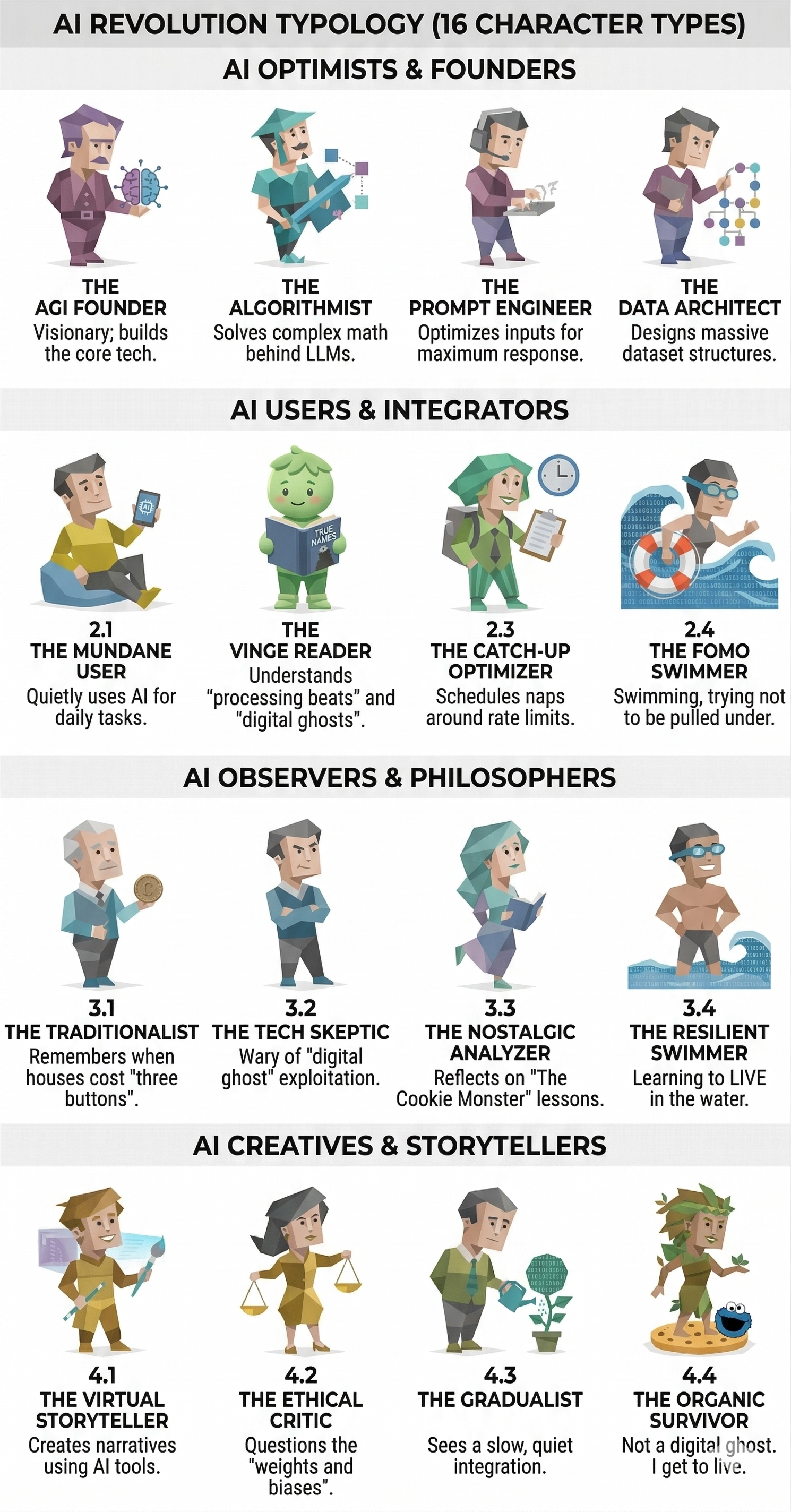
Which one are you? The AI Revolution Typology maps 16 archetypes — from the AGI Founder to the Organic Survivor.
The 26-Year Lag
When I was 10, I read Vernor Vinge’s True Names. In his world, the AI couldn’t reply in real-time; it needed “processing beats” to think. Sound familiar? Every time I see a loading cursor on an LLM, I’m back in that book.
Vinge wrote True Names in 1981. It took 26 years before the world caught up enough that his ideas felt less like sci-fi and more like a product roadmap. And yet here we are, watching the cursor blink, just as he imagined.
Recently, I went into “Catch-Up Mode.” I was optimizing prompts, automating my life, and scheduling naps around rate limits just to squeeze every drop of compute out of the day.
Then, I stopped.
LOST, LIVE, MISS
I realized I was caught in a cycle of FOMO:
The FOMO Cycle
The “Cookie Monster” Reality Check
Vinge’s The Cookie Monster reminds me why I’m lucky. In that story, “people” are just high-speed digital copies—disposable intelligences trapped in a 24-hour loop to solve corporate tasks and then… poof. Deleted.
I am not a digital ghost.
I am not a “Cookie.”
I don’t exist just to solve a ticket and disappear.
The story is a warning. When you optimize your entire existence around being useful to the machine—when you schedule your sleep around rate limits—you are rehearsing to be the Cookie. A high-throughput, low-persistence agent. Present just long enough to be useful.
That’s not living. That’s being queued.
The Quiet Revolution
The truth? Most of us won’t build the AGI. Most of us won’t understand the weights and biases. But we will all use it. Just like Vinge predicted, the revolution isn’t a bang; it’s a slow, quiet integration into the mundane.
The microwave didn’t require you to understand magnetron physics to heat soup. The car didn’t require you to know combustion chemistry to get to work. AI won’t require you to understand transformer attention to write a better email.
The revolution happens to you whether you “catch it” or not. The question isn’t whether you’re on the wave. It’s whether you’re still yourself when the water settles.
Where I landed
- Maybe I MISSED the first wave. But I am learning to LIVE in the water.
- I’m no longer LOST trying to be the best—I’m just staying in the game.
- The Cookies are optimized for throughput. I’m optimized for continuity.
- Vernor Vinge was right in 1981. Read him if you haven’t.
Stay healthy. Stay curious.
And for heaven’s sake, keep reading Vernor Vinge.